Choosing the right company for your cable pulling and installation needs is a critical step that directly impacts the success, safety, and longevity of your infrastructure project. Whether you are installing fiber optics, power cables, or telecommunications lines, the expertise of the contractor can mean the difference between a seamless deployment and costly delays or failures.
This guide details the essential factors to consider when vetting potential partners to ensure you select a provider who meets your specific project requirements.
1. Assess Experience and Specialisation
Experience is non-negotiable. A reputable company should have a proven track record relevant to the scale and complexity of your project.
Relevant Project Portfolio
Ask for a detailed portfolio of past projects, specifically looking for ones similar to yours in:
- Cable Type: Have they worked extensively with the specific type of cable (e.g., high-voltage power, delicate fiber optic, coaxial)?
- Installation Environment: Do they have experience in your installation environment (e.g., underground conduit, overhead aerial, challenging industrial settings, or confined spaces)?
- Scale: Ensure they have handled projects of comparable size and length to confirm their capacity.
Industry Certifications and Training
Verify that the company and its technicians hold current, relevant certifications. These confirm adherence to industry best practices and standards.
- Safety Certifications: Look for certifications like OSHA compliance (in the US) or equivalent local safety training.
- Technical Certifications: Certifications related to specific cable systems (e.g., BICSI, specific manufacturer training) demonstrate expertise in modern installation techniques.
2. Evaluate Equipment and Technology
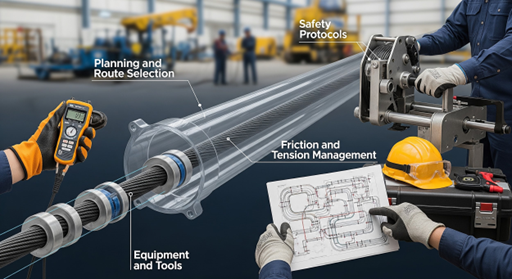
The quality and maintenance of a company’s equipment reflect their commitment to efficiency and safety. Outdated or poorly maintained gear can lead to cable damage, project slowdowns, and increased risk.
State-of-the-Art Tools
A leading company will utilize modern, specialized tools for precise and safe cable handling:
Testing Gear: Ensure they possess and use calibrated testing equipment (e.g., OTDRs for fiber, TDRs for copper) for immediate verification of cable integrity post-installation.
Tension Monitoring: Companies should use sophisticated tension monitoring equipment to ensure the cable is never stressed beyond its maximum pulling tension, preventing internal damage.
Pulling Equipment: Check for professional-grade hydraulic pullers, specialized sheaves, and rollers appropriate for the cable diameter and weight.
3. Prioritise Safety and Compliance
Safety protocols protect both the personnel and your infrastructure investment. A strong safety record is indicative of a disciplined and professional operation.
Safety Record and Policies
- Injury Rate: Request documentation on their safety record, specifically their Experience Modification Rate (EMR) or equivalent local metric. A low EMR indicates fewer accidents and lower risk.
- Method Statements: The company should provide detailed method statements and risk assessments (MSRA) for your project, outlining how potential hazards will be mitigated before work begins.
Regulatory Compliance: Confirm they are fully compliant with all local, state, and national regulations, especially concerning utility marking (e.g., “Call Before You Dig” protocols) and environmental protection.
4. Investigate Project Management and Planning
Successful cable installation relies heavily on meticulous planning, logistics, and clear communication.
Planning and Logistics Capabilities
The contractor should be able to demonstrate a thorough understanding of the logistical challenges specific to your site:
|
Aspect |
Key Questions to Ask |
|---|---|
|
Project Scheduling |
How do they manage timelines and integrate with other contractors on site? |
|
Material Handling |
How will they ensure cable drums are stored, transported, and deployed safely without damage? |
|
Permitting |
Are they responsible for securing all necessary permits (street closures, utility access, etc.)? |
|
Contingency Planning |
What protocols are in place for unexpected site conditions, equipment failure, or adverse weather? |
Communication Structure
A dedicated project manager should be assigned as your single point of contact, ensuring clear, consistent updates and rapid response to issues.
5. Review Insurance and Liability
Adequate insurance is crucial to protect your assets against unforeseen damage or liability during the installation process.
Required Coverage
Ensure the company carries comprehensive coverage, including:
- General Liability Insurance: Covers damage to property or injuries to third parties.
- Workers’ Compensation: Covers injuries to their employees.
- Professional Liability (E&O): Especially important for design-build projects.
- Contractor’s All Risks (CAR) or Installation Floater: Specifically covers the materials and work in progress against damage or theft.
Always request current certificates of insurance directly from their insurer, naming your company as an additional insured if possible.
6. Seek References and Client Feedback
Don’t rely solely on the company’s self-assessment. Independent verification provides the most honest view of their service quality.
- Client Interviews: Speak with references from recently completed projects (within the last 12-18 months) to gauge satisfaction with punctuality, adherence to budget, and quality of work.
Post-Installation Support: Ask references about the company’s responsiveness to any issues that arose after the project was officially completed.
By systematically evaluating potential partners against these six key criteria, you can significantly mitigate risk and ensure your cable pulling and installation project is executed safely, efficiently, and to the highest professional standards.